Friday, August 29, 2014

Bicycle Touring North Georgia


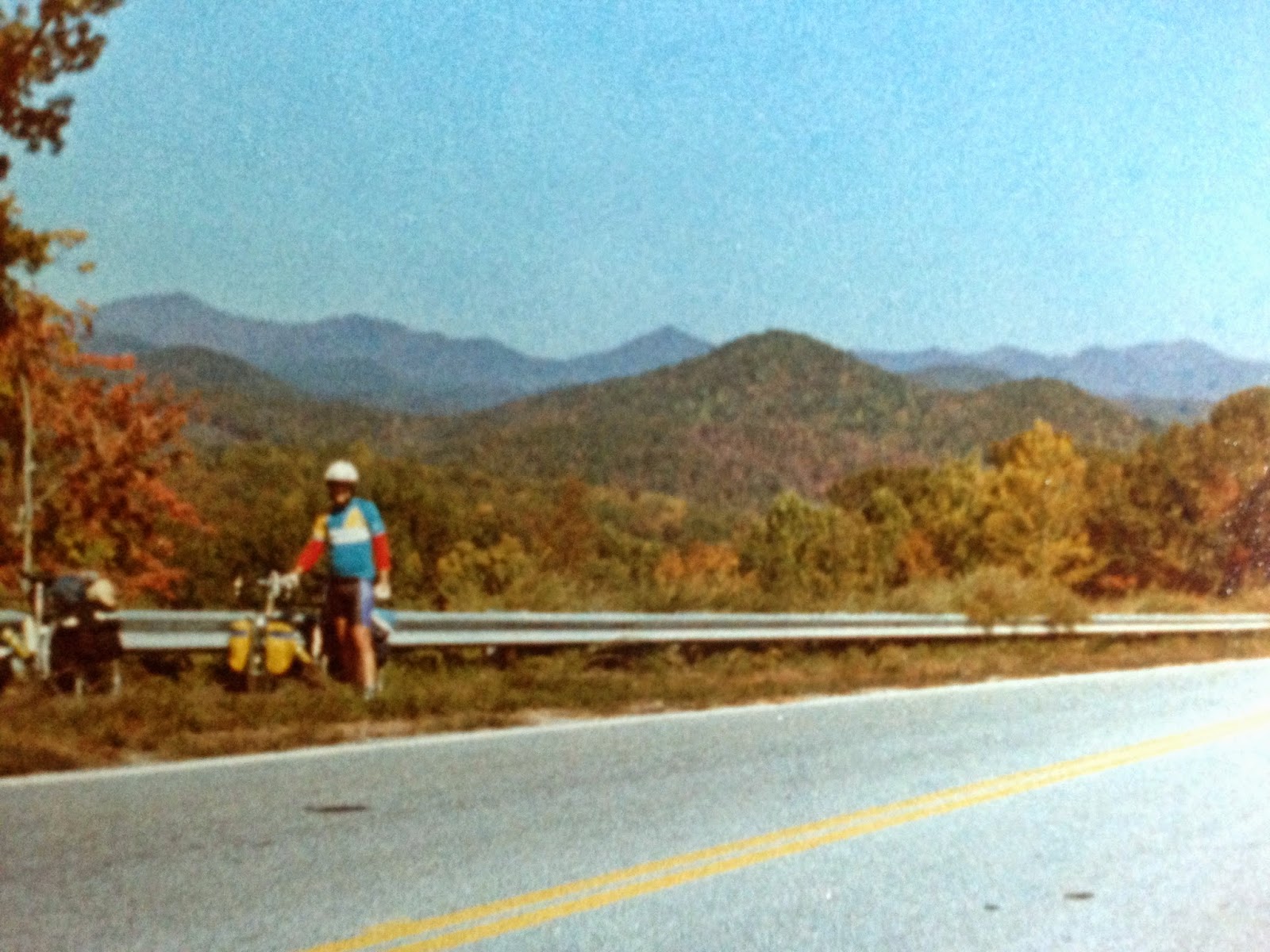
Bill Dion with north Georgia's War Woman Dell in the background
In the years I lived and worked in Chattanooga, TN, I discovered northern Georgia as my favorite destination for backpacking, canoeing, camping and bicycling.  The busy four-lane highways had not yet been built and the small towns and beautiful country was just waiting to be discovered.  It still retains a lot of that charm and I highly recommend you go see for yourself.  Check out the spring and fall festivals throughout the area.
A few years later my friend Bill Dion and I cooked up some bicycle tours of north Georgia and actually bicycle toured the area twice.  I still have some photos of those trips and nice memories.
Bill is a tall guy and bicycling behind him was awesome for me because he blocked any headwinds, making my ride much easier.  Life didn't work the same way when I rode in front, Bill could never get far enough out of the wind to have an easy ride.  We did get along well, though, and that makes for a good bicycle touring partnership.
Cheers!
Our routes started in Ellijay, GA and followed north to the town of Blue Ridge, then east across the mountains to Suches.  We would then drop down to camp at Vogel State Park and cross Richard Russell Scenic Highway and the AT before dropping downhill into Unicoi, making the big left turn toward Hiawassee.  Passing the road to Georgia's highest mountain, Brasstown Bald and back to Vogel again before the long downhill glide into Dahlonega.  We would stay at Amicolola Falls State Park and return to Ellijay.
The warm part of the ride
Except for that first time...  But I got ahead of my story.
While the routes changed a bit each time, we still followed highways 5 and 76 north from Ellijay to Blue Ridge before turning east toward Morgenton.  During our first trip they were building the four-lane highway which prompted several dead-end runs and lots of carrying the loaded bicycles across the mud to get back to the old road sections.  Our first trip we stayed at Two Wheels Only, a motorcycle campground at Suches who welcomed us in on our bicycles.  The food there was great that night and we slept awesomely, due to pedaling up and down mountain passes all day long.
We did camp at Vogel State Park twice and on the next trip used a walk-in campsite where the view from the tent platform was of halfway up the trees.
Richard Russell Scenic Highway is still beautifully scenic, but it was very steep and we had to use our lowest gears and stop lots to rest on the way up.  The weather was cold and cloudy with swirling clouds around us on the climb.  At our last stop before the top I remarked to Bill "You are on fire!", and from the clouds evaporating heat from us in the cold air, we both appeared to be on fire.  We took way too long a break at the top, and I put on my old yellow rain suit to keep warm during the descent.  Bill found that hilarious and called me "downhill man".
Downhill from here
At Unicoi we were welcome to camp but with packing light for bicycle touring, we didn't have the clothing required for dinner at the restaurant.  We rode in to Helen and bought some food, eating at the campsite, watching our clothes dry that night.
A highlight of the next day was the hill along Owl Creek Road.  The road is pleasant and very quiet until you reach the wall.  It went straight up about as steep as you can drive road paving gear down, for what seemed at the time like hours.  Maybe we had aged since the first tour, but the second time we rode Owl Creek Road we were astonished we had no recollection of the pain of the first trip's climb.
The drop off the mountains into Dahlonega the next day was just plain wonderful and we just missed the bad weather coming in.  A big thanks to the gentlemen who watched our bicycles for us while we viewed the historical film at the old courthouse.
Once again, we found ourselves climbing an amazingly steep hill into Amicalola State Park to get to the campsites.  That steep route has since been rebuilt to make it more safe and they have built an awesome lodge at the top, near the start of the Appalachian Trail.
Laundry at Unicoi
Here's where I left off with "that first time..."  In the morning, Bill's brakes gave out while going down the big hill on the last curve.  He crashed, taco-ing his front wheel and launching panniers and stuff everywhere.  I was behind Bill and got to witness everything.  Bill landed in the grass along the roadside and was mostly unhurt.  After finding his missing glasses lens, we walked his bicycle down the mountain to the welcome center.
I left my panniers there and got to pedal a most awesome bicycle ride into Ellijay that day by myself.  I was swooping past everything, riding fast and free, unencumbered by my loaded pannier weight.  It was an awesome experience I'll never forget.
I picked up my truck and drove back to get Bill.  We drove on south out of the mountains, making it to High Falls State Park where we slept for the night before getting home to central Florida the next day.

Friday, August 22, 2014

We chose bicycling to travel in north Florida


Our loaded mountain bicycles at the corner of Where and Am I?
Walt Foy and I bicycled a back roads route through the farmland of northern Florida, riding a loop from Florida Caverns to Three Rivers State Park and back over a 2 day weekend.  The whole route can be driven in about 3-4 hours the same day and still leave time to tour the Caverns before you leave, but I suggest you try riding a bicycle instead.  Moving along at 10 MPH is the best way to really see the land and experience the topography.  You also feel a sense of "earning" it when you carry your camping gear along the route.  With the low amount of traffic and with only one hill, it was a pleasant ride.
We drove up on Friday, camping at Florida Caverns that night.  In the morning we pedaled out into the country and open farmland.  I remember it was cool weather, but not cold.  The clouds were few and bicycling on our mountain bikes was easy.  Walt didn't own a touring bike, so I left mine at home and we rode our mountain bikes instead.
In the afternoon, we reached the bottom of a large hill where we could see the campsites to the left in Three Rivers State Park.  However, we had to ride uphill to get to the entrance, then coast back downhill to pick a site by the lake.  The bathrooms were clean and the hot showers were welcome.
Waiting for the coffee to kick in the next morning
Walt was watching an osprey dive for dinner across the lake from our campsite when I returned from the shower.  After dinner a couple in a huge motor home bus parked next door to us invited us over to visit.  I think they were interested in us riding bicycles and camping in small tents that took less space than the closet did in their bus.  I know I slept well that night.
The next day was cool and overcast, and after barreling down the hill exiting the park, we rode along more back roads and beside farmland until we got back to Florida Caverns.  After a shower we enjoyed the excellent tour of the cave, delighted to be just a few feet underground in Florida.  I highly recommend the Florida Caverns tour with its interesting geology.

Friday, August 15, 2014

Devil's Head National Forest Lookout Fire Tower

View of Devil's Head looking west from Castle Rock, CO
Devil's Head is located in the Pike National Forest a few miles west (and above) Castle Rock, CO.  It has a National Forest lookout fire tower perched on top of the granite there at 9748 feet above sea level.

Originally used from 1912, then built in 1919, and updated in 1952 to the current lookout, the Tower has been in constant use for over 100 years.  For campers there is a campground nearby, LINK HERE.

The Fire Tower is on the U.S. National Register of Historic Places.  A tiny caretaker's cabin is located below the tower, the Ranger carrying food and supplies in by backpack weekly.  Still today, it is the last "manned" fire tower in Colorado, maybe in the United States, all the others being automated.  That makes it somewhat of a tourist attraction and a great place to take your kids.

The day we went, the parking lot off Rampart Range Road was packed.  The summer weather in the Rockies was awesome!  The trail was an easy hike, with lots of views and neat Pikes Peak granite formations along the way.  At the end our trip was rewarded with a card signed by the Ranger in the tower.
Pikes Peak Granite
The view from the top
I am a Squirrel : )
Those last 143 steps up the steel stairs were steep, but the 2.8 mile approach trail is rated easy.  The view is well worth the effort and you can see 100 miles in almost every direction.  It is like looking out onto a flat map before you, the hills and valleys seem all the same.
Counting steps
Getting there is easy, from Denver, go south on highway 86 to Sedalia.  Then go right at the light onto CO 67.  Turn left onto Rampart Range Road and follow the dirt road to the parking area on your left. Beware of weather closures.
Devil's Head Lookout Fire Tower

Friday, August 8, 2014

Castlewood Canyon State Park

From the Castlewood Canyon rim
Nestled along the front range in central Colorado is Castlewood Canyon State Park.  The ridgetop portion of the park includes picnic sites, mountain views and hiking trails, while the lower canyon section of the park features historic sites, hiking trails and more picnic areas.  While no overnight camping is allowed in the park, the day use area includes 100 miles of trails.
View of the Highway 83 bridge from the gazebo

Cherry Creek

Near the old lake that formed above the dam
In the historic sites area are the ruins of a stone walled pioneer home, and the Castlewood Canyon dam. This dam burst during abnormally heavy rains in 1933, sending a 15 foot high wall of water flooding through Denver.  Today there are trails to both sites.  Please stay off the dam and watch for snakes.
We used to live in Castle Rock and visited the park often.  It is Cherry Creek that runs through the park.  For a bit of history, Denver was originally built at the confluence of Cherry Creek and the Platte River. The REI store is located there now and you can hike to Denver (with some road walks) along various trails all the way from the Castlewood Canyon park.  I bicycled that route some time ago.
Reaching the park is easy from the Denver area.  Go south on I-25 and take exit 182 onto State Highway 86.  Go east on 86 to Franktown.  Turn south on State Highway 83.  The park entrance is on the right in about 5 miles.


Friday, August 1, 2014

The Haulover Canal


Haulover Canal Historical Marker
People have been dragging canoes and boats across a thin strip of land between the Mosquito Lagoon and the Indian River Lagoon for longer than these places have had names.  That thin strip of land is now called the Haulover Canal.
Drawbridge
The drawbridge you see today was built in 1963.  The Army Corps of Engineers took over the area in 1927, widening and deepening it to the size it is now.  The boat ramp, launch & parking lot were built.  Recently the ramp road has been paved with a Manatee Watching deck built on the north side of the canal.
The rules are simple, protect the manatees!
In 1887 the Florida Coast Line and Transportation Company started the canal at its present location.
In 1852, contractor GE Hawes dug a 3 foot deep, 14 foot wide canal using slave labor.  Heavily used by the riverboats and local traffic, it was completed just prior to the third Seminole War.
Going back in time, people pushed and pulled boats across mulberry tree bark which was laid on the ground.  They used logs later on to roll the larger boats and schooners across.
View to the southeast
This is a busy spot for launching small boats and kayaks into either lagoon to spend the day.  Part of the Intercoastal Waterway, large sailboats and motorboats pass through here daily.  I have fished there many times, catching nothing while watching paddlers unload their huge catches in front of me.  The place has a quiet appeal and the current makes paddling interesting as it changes direction with the tide.  I launched a canoe here a couple of times and spent a whole day around manatees while exploring the coastline.
How cool is it?
The new manatee watching area is nice with paved parking and a railed walkway above the water.  They have also added a thermometer to a sign so you can assure yourself the water is cool enough to attract manatees.  Educational signs have been added for children and there is school bus parking also.  The walkway has a plaque in memory of Wildlife Officer Joseph Oliveras, who served this area faithfully from 1971 to 2001.
Thank you and yours for many years of service
The Merrit Island National Wildlife Refuge surrounds this area with incredible bird watching opportunities all around.  Established in 1963 as an overlay of the Kennedy Space Center and containing 140,000 acres, it is a large place and since the shuttle program has ended, it is very quiet.  Pick up a pass at the visitor center every day from 9 am to 4 pm except Sundays and Federal Holidays, and tour Black Point Drive to see wildlife.  To fish here (for free) you need to pickup a free fishing permit.  If you want to watch large wildlife, look for turtles and alligators.  Yes, alligators seem to like the brackish salty marsh water so don't let them surprise you!
To get here, travel south on US 1 from New Smyrna, turning left onto SR 3 about two miles south of Oak Hill.  From I-95, take exit 220.  Drive east on SR406/Garden Street four miles and cross the Max Brewer Causeway Bridge.  The visitor center is 4 miles east of the bridge (stay right at the fork in the road).  To get to the Haulover Canal, take the fork in the road to the left.

Friday, July 25, 2014

St. Augustine Lighthouse


St. Augustine Lighthouse Keepers House Before Restoration
I have been visiting St. Augustine, Florida for many years, as a both a resident and an out-of-stater.  In the early 1980's I visited the lighthouse, which back then was a burned out shell, fenced off from all since arson destroyed the Keeper's house in the 1970's.  Birds nested in the ruins.  Trash blew past the fence.  No one was there but me.  The sign behind the fence promised a future restoration project, so I took a couple photos.
Since then, St. Augustine has risen to the challenge.  The Junior Service League restored the Keepers house and created a museum and store next door to the lighthouse which opened to the public in 1988. In 1993 it began allowing tours up to the deck of the freshly painted lighthouse.  In 2002 the US Coast Guard turned over the deed of the lighthouse to the St. Augustine Lighthouse and Museum, Inc.
In 2011, over 213,000 people visited the site which was run at the time by 272 volunteers.  Other lighthouses around the nation look to St. Augustine as an example of one of the most successful lighthouse restorations in our time.
The LAMP, or Lighthouse Archaeological Maritime Program runs varied programs including Lost Ships, Sonar Workshop and others.  They also run a 4 week field school working on marine archaeological discoveries of about 170 wrecks in the area.  This is an active series of programs and is worth checking out for your next visit.
I too have climbed the 219 steps of the lighthouse with my family and enjoyed the view in all compass directions from 165 feet above the ground.  I thought it may be fun to create a video of the lighthouse.  It was cool to take photos of my older 35mm prints and add some new video, shot on location last week just prior to the daily summer downpour.  Enjoy the short video here.

Friday, July 18, 2014

The Yearling Trail in the Ocala National Forest

The Yearling Trailhead sign, across SR 19 from Silver Glen Springs.
Last week I traveled to the Ocala National Forest to hike the Yearling Trail.  If you didn't know, the Yearling Trail is named for a fictional story written by Marjorie Kinnan Rawlings in the late 1930's about a family subsistence living in the Florida scrub, who's son adopts a wild fawn.  I read the story while mending my broken hip in 2012.  The story is written conversationally, in the way the people spoke then, and it covers the antics and adventures of adolescence and the hardscrapple life they lived.  Most amazing to me is also what was most amazing to Rawlings, that these people lived with absolutely nothing, yet were happy.
They made a film about The Yearling, shot on location at Pat's Island about 10 years after the book was published. You can read more about the story here.
Marjorie Kinnan Rawlings visited the Long family living on Pat's Island and wrote from the stories they told, fictionalizing the people's names while covering their everyday lives.  The story about the fawn happened at least 50 years before that time.  She was a great listener, capturing the details and phrases of a time long past.  Her book Cross Creek is also a very good read about old Florida.
The Ocala National Forest created the hiking trails in the Juniper Springs Wilderness area that illustrate the Pulitzer Prize winning story.  Markers along the trails are set where homesteads used to be and where cemeteries, dip tanks and sinkholes still are.  You can find a map here.
Pat's Island is a hill above the Florida scrub that is covered with pine trees and is cooler and wetter than the scrub around it.  Much like an Island surrounded by water, Pat's Island is surrounded by the poorer and dryer scrub lands around it.
Hot & dry Florida scrub with lots of wildlife
Trail kiosk
From the Trailhead on highway 19, you hike west through one half mile of hot Florida scrub.  The white sand is quite dry and the trail offers almost no shade.  The scrub has a few towering pine trees but is mostly low shrubbery, bushes and palmetto.  It still supports a lot of wildlife like the beautiful and endangered blue scrub jays and the bright red cardinals that I watch flit from branch to branch. Wear a hat, bring lots of water and use sunscreen.  Kiosks along the trail explain the story and the trail markers.  There is also what looks like a blank white sign.  This sign used to explain the land contains archaeological materials that are not to be dug up or removed, but the paint is worn and faded away.  Practice Leave No Trace and leave the archaeology for other hikers to discover.
Blank archaeology sign, the far trees in the background are Pat's Island
You will see Pat's Island ahead as a dark line of trees as you climb towards it.  Once you reach the trees, look back at the rolling scrub lands and you can see that you have, in fact, climbed a hill.  In the shade it was much cooler and the wind in the trees was peaceful.  At the first marker, I took the Jody's Trace trail to the right to follow counter-clockwise around Pat's Island.  This portion of the trail was not cleared yet and I walked off it repeatedly.  By carefully watching the yellow blazes on the trees I could follow it, but I had to pay close attention as the shrubbery and wiregrass had grown to cover the trail in many places.  There were some careful balancing moments with multiple fallen tree crossings, but with patience and a walking stick you will be fine.  The volunteers must clear these trails annually to prevent trail loss, and I expect they will get to this section before summer heats up.
Jody's Trace trail sign, turn right

Disappearing trail, must watch the yellow blazes closely
I did stop from time to time for a photo and to listen to the wind.  Once when stopped I heard the knock-knocking of a red headed woodpecker and was able to get a photo of that elusive bird.
The trail passed through shade and sun, going through several burn areas, some with tall widow makers all around you.  Once dead, these sentinels stand strong for a decade or so, then are silently toppled by wind.  Do watch and be careful.  I did feel the sense of stillness around me a few times, surrounded by stark sentinels on all sides, dead oak trees and dead pine trees where the fires once burned too hot.  But then I moved along into shade with birdsong and the wind sounds through pine needles keeping my thoughts company.
Widow-maker propped over trail by a very thin sapling

Look closely between the trees to see a red headed woodpecker knock-knocking
Coming down a slight incline the trail passes adjacent to a dip tank, where cattle were driven through a chemical (crude oil?) filled trough in the ground to kill ticks.  Though it is nearly 100 years old, do NOT drink the water!  Here is a video about how this works.  Further along a marker showed there used to be Calvin Long's field to the right, but the trees have reclaimed it all.
Dip Tank
Once a field
 The next marker was at a trail junction, where you could either travel south to a cemetery and the return trail, or hike north then west to the Florida Trail.  It is also the site of the sinkhole.  About 100 feet across and at least 60 feet deep, this sinkhole used to trickle drinking water to the 12 families who used to live here.  The southeast side has been shored up to prevent the sinkhole from filling in.  There are dogwoods and hickories here.  From the rim I couldn't see any water in the catchments or dripping from the now dry moss along the side.  I think the water table has changed.  With the recent rains, there should be some surface water lingering, but I didn't see any.
Trail sign, left to cemetery, turn right to Florida Trail

This sinkhole used to supply drinking water to about a dozen people who lived here, now it is dry
There used to be Patrick Smith's homestead here, right next to the sinkhole, but there was no sign of it on the ground besides the marker post.  Maybe on another trip with more time I can look closer for foundation or fireplace stones in the underbrush.
Trail sign at the Florida Trail, turn left

Florida Trail clean campsite
I took the trail to the north around the sinkhole, then west following the Major Churchill road.  This trail was immediately wider and better maintained than the trail I had been walking and I was able to pick up my pace.  I soon came to the intersection with the Florida Trail and turned left (south) at about 2.5 miles.  It was familiar to be following the orange blazes again.  A campsite came up on the left very quickly, the fire pit was cold but the land here was clean of the usual National Forest trash.  Good job campers and trail volunteers!
I pushed on another half hour along the Florida Trail going up and down the rolling terrain to the next trail marker and turned left (east).  This was a high point, with the land falling off Pat's Island down to the scrub below.  An old cistern was sunk in the ground here and it is surrounded by a low fence.  The map shows this was the site of Reuben and Sara Long's home.  If that is correct, what a view they had!
Return trail sign, turn left

Fence surrounds sunken cistern at the Long's home site

The view goes on forever and this photo just cannot show it the way I saw it
The view to the south held me in awe, a spiritual word meaning I was witnessing something like the grace of god in nature.  I was certainly feeling joy!  The land was rolling up and rolling down, sparse trees were poking through the scrub, small islands of trees dotted to the left and the right, and the hills were rolling into valleys just about as far as you can see at one time in Florida.  I could see the Florida Trail punch through the scrub here and there.  It was like while I was hiking on the trail, I hadn't seen the forest for the trees, but now I was seeing the forest and seeing the trees and so very much more.  I paused in the shade a while to take in and enjoy the beauty.
On the trail again, vultures circled far above on the air currents, looking for food.  About halfway back to the first trail junction, there is the Long Family cemetery to the right of the trail. There are several headstones, most of them are marked and the fenced plot was kept clean.  Reuben & Sara Long are buried here, along with many of their children.  Someone takes care of this site and that did my heart good.  The short trail to the north connects with the sinkhole.
Along the trail

A sign at the cemetery gate

Reuben Long, a Confederate soldier passed in 1915

Sara Long, Reuben's wife passed in 1909


Many family members are buried here and the cemetery was kept very clean, return to the trail and turn right to return to your car
Continuing along the main trail for a ways you pass a marker for where Calvin Long's homestead used to be. This was the homestead where the Yearling movie was filmed and is the place where Marjorie Kinnan Rawlings visited the family and learned of their stories.  Again, I could see no sign there ever was someone's home, farm, barn or that a family once lived here.  This trail is wide, and this used to be the Grahamville road, a wagon trail through the woods.
I passed another post marking the Cora Long home that used to be there.  Again, there was nothing to betray the fact to the casual hiker.
I came to a post with the numeral 11 on it, but only had 10 posts marked on my map.  At the trailhead kiosk, marker 11 shows an old cedar tree, which was not at the post with the 11 on it.  Maybe it was burned in a fire or I just missed it.  Cedar trees growing naturally in Florida usually mark where an outcropping of limestone is 30 feet or less below the ground.
More of Pat's Island forest

Cactus in the scrub along the trail back to the car
I finished the loop around Pat's Island when I returned to the first trail marker, a 4.5 mile hike.  The half mile approach trail makes this a full 5.5 mile hike.  I understand the Florida Trail trailhead walk is a shorter walk from the north side and I will try that on another trip.  I left the cooler temperatures and shade of Pat's Island and walked back along the entrance trail through the scrub to my car.
If you are driving, from Orlando, go east on I-4 to Deland and exit on state road 44 and follow that west to town.  Go right (north) on highway 17, and stay left on 17 when 92 splits off to the right to Daytona Beach. Follow 17 north through the country to Pearson, where you turn left (west) onto State Road 40.  Cross the St. John river at Astor and follow to highway 19.  Turn right at the light (north) and follow about 7 miles to the Yearling Trail sign on the left.  Park here at the trailhead for a fine walk.  Silver Glen Springs is directly across the road.
Camping is available at several National Forest campgrounds, with tent camping for backpackers along the Florida Trail.  For camp sites, check the Ocala National Forest website HERE.
Cellular service in the Ocala National Forest is sparse at best.  Do carry your 10 essentials, wear a hat and carry a couple quarts/liters of water and make sure you leave written instructions of where you are behind with a friend or a loved one.